Showing posts with label advice. Show all posts

Tuesday, August 13, 2013

The Best Writers are Sadists


Yeah, you heard me right. And no, I don't mean this in some kind of sexual-masochistic 50 Shades of Grey kind of way. Pain is the most important part of your story-- fictional or otherwise.

Though I've always pretty considered hardship to be the most vital ingredient in a successful story, it was only recently that I pondered the extent of it and that truly meant on existential level. With my book nearing the completion of its final draft, my thoughts turned reflective and philosophical. I thought to myself, "Why am I such a jerk to my characters?" Not to spoil anything, but I hurt them-- brutally so-- time and time again. Why did I do this? If am the God of my story and I love my characters deeply, why do I torment them so?  


Simple. I had no choice. They were born to amuse a reader... and the other way to do that is make them writhe in agony. I know it's cliche, but there really is no gain without pain. My story would be blank without adversity. The protagonist wouldn't be the man he is without loss, nor would any of the other characters. I mean, the villains wouldn't be villains at all if they had no one to hurt. The characters would have nothing to even do or say if they didn't have to overcome and endure pain-- or prevent it from befalling others. That's what you, the reader, comes to see, don't you?  A story about a gladiator would be dull without a lion, and it would be just as pointless if that lion didn't manage to sink his teeth into the guy once or twice. Book readers truly are no different from the spectators of the Roman Colosseum, cheering for feats of glory and crying out for blood. Red is color of entertainment. There's no denying it.That's why utopia will always be a dystopia. Heaven will always be Hell. In peace we are bored... discontented. Humanity needs pain to feel alive. 


I'm not ashamed to know and embrace that seemingly cynical facet of human nature. Life is not a full, satisfying experience without failure and depression as we will have nothing to measure our success and happiness against. If you think about it, it's not really cynical statement on our nature at all. If anything, I'd say it's a positive one. It's proof our need culture, and our yearning for purpose. The echo of our collective calls to greatness. We want to feel real emotions. We want to be immersed in compelling dramas. See a good fight. Fight a good fight. Win a fulfilling win, and see others attempt the same. That means blood and bruises-- the shit being kicked out of both sides. Surprises. Thrills and chills. The beaten down dog rising from the ashes to take a bite out of the bigger dog. 

The best stories are the roughest rides, no matter where they end up or what happens along the way. Revisiting the dog metaphor, sometimes the dog loses in the end yet wins in a small way. Perhaps he fails miserably in all aspects-- maybe even DIES-- but in doing so he manages to achieve a meaningful emotional reaction in another character. That's tragedy at its finest-- something Shakespeare, arguably one of the greatest storytellers of all time, harnessed and perfected.  

Why do we like seeing that though? Why do we crave grittiness; depression? Those are deep questions, but they don't even begin to dive deep enough. Humanity doesn't want to be depressed, but the reality of it is that we are depressed. That's because as adults, we are in a constant state of decline. Growing worse and worse, until we finally lose the inevitable battle against our own mortality. So that's why we like it. We relate to it. We know it and understand it. But the tragedy is only one part. Half of the equation.

Pain is important, I believe, because of the fact that we expect it to end. We see a resolution. The conflict is brought to an end, and the hero escapes his conflict by his own two hands. This is something we all wish to do ourselves. Feel accomplished. Overcome our problems. Achieve great things. Even if the hero isn't even a hero at all-- morally speaking-- he or she still does something to their end. When you break any aspect of storytelling and life itself to its most basic form, you'll find pain. Don't believe me?

Here's a list of what most writers tend to accept as the most important elements to a successful story:


1. Likable Characters
2. Anticipation 
3. Immersion
4. Conflict 
5. Satisfying Resolution


1. You like characters you can relate to-- ones that seem real. The best characters? Ones that feel real emotions. Humans not robots. Ones that deal with baggage... and PAIN. How we react to pain defines who we are.

2. What creates excitement? Danger. What is danger? The possibility of experiencing PAIN. Pain is the ancestor literally to every phobia.

3. Life means constant struggle and growth. The most realistic thing is for a character to overcome PAIN and remove it-- either emotionally or physically. To wake up from a dream you pinch yourself. Pain tells us that things are real.

4. For you to want to fight against something, that thing must have caused you PAIN in some way.  Without pain as a motivator, your fight lacks all meaning. 

5. The best endings are the ones that leave no loose ends and make the PAIN we felt to get there worth it. Pain is either the result, or the force we managed to stop.


Alright, that's enough. I'm sure by now you're sick of the word pain, (Oh no, there it is again!) but I needed to hammer its importance into your head. What you should take from this beyond any applications to storytelling is that you shouldn't run away from the pain in your life-- nor lament its constant presence. Rather, as you should with writing fiction, embrace the hardship and use it as a source of strength. Turn yourself into a compelling character. Use it for the benefit of your own biography. There's no way to escape life's upsets, so allow yourself to cry every now and then. Let the sting be the back-story to your future greatness.  

We humans are creatures that are constantly feeling. Evolution and advancement always begins with a problem to overcome. Pain makes up a huge chunk our of lives. If you can't see it as a positive tool for personal growth, then you are wasting most of your life. The same thing applies to your story. You are the God of your world, responsible for everything that happens. If reality doesn't spare us from hardship, why should your fiction.


So be a sadist. Give your readers the blood they secretly pine for.  

- B

Tuesday, May 28, 2013

Writing Recipes #2: Meaty Characters

Make your characters... 'moo-ving.'

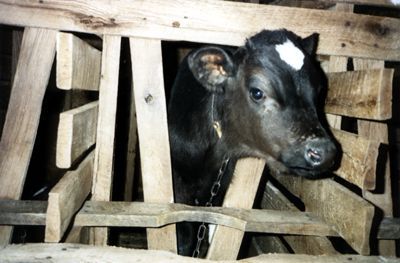
Last time, we baked a confectionery delight-- a lovely Protagonist Pie. This time we're going to make a meal that is quite different. For our needs, cooking is required... killing even. Sugar is replaced with salt for rubbing in wounds. The presentation is lost, charred or even bloody. This may be the most antagonizing meal you'll ever make. Careful, you might burn yourself in the process.


VEAL DE VILLAIN

This is a choice cut, a dinner that should not sit well upon being digested. Vegetarians and humanitarians look no further.


STEP ONE: Kill innocence 
Much like a baby calf, our villain must kill something of innocence. That might be something internal or external-- taken in a literal sense. No cut of meat is born a villain... its soul must be butchered-- carved and contorted into a bloody piece of veal. Greed, lust... these are motivators, but weak ones. A great villain is disturbed, changed in some way. Show the eater of your veal the death of its innocence. Horrify them.


STEP TWO: Determine Color
You must decide how dark your want your meat-- or how red. Prior to any seasoning and prepping, choose whether you want a rare veal willing to draw blood or be lethally under-cooked. Is the soul charred beyond recognition? Is it medium? In between and seemingly good, putting on a persona and keeping its nose clean by manipulating others?

STEP THREE: Cook the Grenade
Once the color is decided, throw the veal in the oven. As you cook, give the proper heat and motives. Allow the eater to understand why the meat tastes the way it does. Allow them to detect subtle hints of how it was cooked while still maintaining an air of foreboding mysteriousness. Be sure to burn in grilling marks, scars, external evidence to the pink evil inside the Villainous Veal. Be sure to check on your meat occasionally to see the progress of its development-- the hardening of its character. It is not uncommon to burn the veal to a crisp by the time the story ends.

STEP FOUR: Add Seasoning
A villain has its quirks too-- its idiosyncrasies. What grass does did it graze upon as a young calf? What does it revel in now? How about what it hates? Hate. Hate and a perversion of love are your greatest seasonings. Dark ambition is almost required. Make it strong tasting, perhaps even chilling. Make it so bad that the eater won't be able get the taste from their tongue, or so devilishly good they can't stop eating it up. The right dressing can amaze... but it can sicken... nauseate... or kill if poisoned. 

STEP FIVE: Support with Sides
Optionally, (yet highly suggested) you may support your dark dish with some sides that will compliment your Villianous Veal and play off its sinister flavor. Perhaps a kind pawn, like a healthy yet doomed veggie. Maybe an equally mashed potato-- made evil by the meat's gravy. Tasteless and useless garnish goes a long way, like a henchman used only to fodder the villain's presentation. A lonely villain can be extremely effective, but one surrounded by sides is a force to be reckoned with.

FINAL STEP: Use your own Darkness
The cook needs to always cook a bit of itself into its creations, even the culinary disasters. Seek into the darkest recesses of your mind to find an ingredient you've chosen to hide from others. Putting your own evil into the veal--regardless of how small or repressed it is--makes the taste explode on the plate.


Now your cooking with hate, making a tragic masterpiece. Your veal may not sit well with many, but it won't   be forgotten. After all, we always remember the meals that made us sick. Food poisoning can be deadly, but it remains a constant fear in our minds.

- B

Friday, April 26, 2013

The Secret to Life


Of all the things we seek in our lives-- success, love, acceptance, car keys-- one particular item ranks the highest on our most wanted list. No, want is not even close to being the right word... I'm grossly underselling the value of the object in question. This particular aspect of our existence is so unequivocally vital that no phrasing in any method of human expression could ever adequately capture the-

Oh, enough hype already! This blog entry is about one's purpose. It's about your, mine and everyone's role in the grand scheme of things. I speak of course of the ever-sought after cosmic answer: the secret to life.

I'm aware of how bold of a claim this is. I'm sure you're thinking to yourself--and quite logically, might I add-- how could one lowly blogger with little acclaim and no name for himself possibly think he's got the answers? I'm on even terms with you, I'd say... for what difference is there in a man but surroundings he keeps? I bid you only the benefit of my words, so listen and allow my words to serve as their own resume. You see, life's secret is not well kept-- anyone and everyone can figure it out and understand it.

The most common answer a man will give when questioned about life's meaning is that it is dependent on success or happiness (often the two are regarded as synonymous),  but I'd say both are only partially true-- far too broad to be accurate answers. What qualifies as happiness and success can mean any manner of things due to the wildly divergent perceptions of the human population. So then, what's my take? What do I find to be the meaning of life? One word: experience.    


Saturday, April 13, 2013

Let the Force [Not] Be With You


This entry is both a change of pace and a return to form. I recently committed to a month-long poetry spree, tasking myself with the daily creation of a poem. It is with a heavy heart and an enlightened mind that I must now break that promise. It is not for lack of energy, effort or ability; rather, I learned something profound during my venture into the realm of spoken word. Something vital. A sagacity that has truly altered my general perspective for the better. In my hand, I grasp the key to writing and its various incarnations: natural flow. More specifically, the lesson I learned is that you cannot force a creative reaction. Ideas must be born naturally, and out of a genuine desire and passion to do so.

The epiphany came through the course of my poetry spree, as I found that the further along I pushed into the endeavor, the more diminished the quality of my work became. When I'd first started, I was firing on all cylinders-- I had a rhythmic frame of mind. The first few poems I wrote exploded on paper, filling me with pride with each read back. The poems conveyed messages, brimming with true power and emotion-- their symbols effective. Alas, by the time the second week's batch arrived, the dough had soured. What happened? How could this be? Doesn't practice make perfect? Honing one's craft is indeed a boon, yet forcing oneself to churn out shoddy creations like some kind of a soulless factory is a bane. Nobody wants to see acting that feels forced, nor does anyone want to read forced writing.

Force and art good bedfellows do not make, and I'd go so far as to say it force can ruin every action one can take in life. Brute force is one of the most garish and unappealing means to an end I can fathom. It's Plan Z, the last of all resorts. An arranged wedding never fairs well, and forced love fairs equally foully. Life doesn't exist within the screen of a calculator. You can't tap a few buttons and expect a clean, clear result.  A conclusion must be arrived to naturally and in the most practical and beneficial way possible, regardless of the time and effort one must spend to get there. When coaxing a skittish cat to eat food out of your hand, you don't chase it down rapidly and violently shove food down its throat as it desperately claws for freedom. No, you hunker down submissively, whisper gently, let it come to you and eat the food cutely off palm.

Trying to write through writer's block--something I see as just not being in the mood--is equally futile. If you force a girl to have sex with you when she doesn't want it, that's a legitimate rape. Why would you rape your mind? Don't force yourself to do anything you don't want to do. Let your creative juices flow when they ready to do so. If you try drinking your creative spring before the spring of inspiration bubbles forth from your brain, all you'll be doing is churning out futility. You'll suck, like that annoying sucking noise made by children when they refuse to come to terms with the end of their milkshake.

So don't force anything. It's good to give yourself the kick in the pants you need to get up and go every once in a while, but let art make itself. Be a participant and a team player in your creative process-- not a desperate agitator and bully. Instead of blowing a whistle and demanding results, command a smile and create and guide a success like a thoughtful and caring therapist-- willing to offer as many sessions as needed until what needs to be done gets done.

Remember, you cannot force love... and love is the most important ingredient in anything worth doing. Especially writing.


- B

Saturday, March 23, 2013

LOMP: Laugh Out of My Prison


This entry is intended for a special someone in my life who unfortunately suffers from GAD, or Generalized Anxiety Disorder, but it also applies to anyone who feels an intense fear at some point or another. That means it applies to everyone-- myself included. Constant anxiety is nothing to be ashamed of, as fear is an integral part of human nature. You're not strange, if anything you're even more human than others. Humanity is a species beset by weaknesses, but the act of overcoming them is what defines our race. Throughout the annals of time, other humans like yourself have faced the fears you faced-- rational or otherwise. They evolved and adapted to combat and grow past them... and you will too.

The worst fear a man can face is a fear without a face. Why? Because it's untouchable and unable to be proven or measured. The uncertainty adds to the danger, and you're always left feeling insecure. In that same sense, the hardest prison to escape is that of our own minds. For so many people, that prison is their fate and they feel like they'll never find parole. They live stagnant lives, frozen by their apprehension. Sure there's drugs like Xanex and the like, but for most people their side-effects only make things worse. If professional therapy doesn't even work, where can you turn?

"Hopeless. Everything is hopeless. I'll never get better. Things will never change. There is no cure." 

Anxiety is a beast that creates a never-ending cycle of terror-- because you get anxiety... about anxiety.

But that cycle can and will END. Here's some good news: matters of the mind can always be conquered. If you break your back and become paralyzed for life, there's not much you can do... but with fear? You're not physically paralyzed at all! Your boat is chained down by an imaginary anchor. You know that prison cell you're in? No walls. The only thing keeping you trapped inside is... well, nothing. Good news, you're free to go. Wait... why are you still standing there? I said you could go...

Sunday, March 17, 2013

Writing Recipes: Just Desserts #1

B's Protagonist Pie

Make a character  that readers will eat right up!


- 6 cups: Weakness
Essential. Vary the amount for the desired taste-- less for sweet or more tart. A believable brand of weakness works best. Fear is always your friend. Maintaining balance is vital when adding this ingredient-- as with all things. Too little and your protagonist pie comes out fake, too much... your pie comes off as a bit needy and unlikable. Unless you're baking a pity pie, in which case you should dump the stuff in!

- Fill a mixing bowl with: Background
The foundation of your delightful dessert. Must mix well with all other ingredients and must feel real. Do not let this part be obvious to the eater, new cooks! It should be tasted subtly between bites and tasted at just the right time.

- 3.56 tsp: Quirk
Pepper in as desired to make your Protagonist Pie stand out from the rest. More- if you want it to be a weirdo, less- if you want a more serious pie. Try to be unique. We have enough chain smoking wise cracking detective pies. The eater desires new  flavors, aspiring bakers!  

- 2 tbsp: Strength
Your Protagonist Pie needs a kick-- robust flavor. (A pie can gain or lose this over time) Add in any kind of strength. Give it skills, abilities. Things that make the pie cool and interesting. You need to take care not to add too much strength because that makes your creation unrealistic and hard for an eater to relate with.  

-  Don't forget the Dynamic 
Change in your confection is the yeast that makes it rise up to great heights. Forget to add it and your static cooking falls flat-- ruining the entire pie. Make sure the texture of your pie ends up fitting the intended mold but able to be decorated and eaten away at over time. Progression is a key ingredient to all the best protagonist pies.

- Stuff full of: Beliefs
A proper pie must be baked with a drive in mind. What does it think? How does it think? Who does it hate? Love? Does it hate politics? Does it care for religion? Humans are full of opinions, so stuff your protagonist pie properly.

- A stick of: Interests
Interests make any pie appealing, bringing your creation to life. Throw a bunch in for better taste, but not too many because they can be quite fattening. If a protagonist is too bloated with hobbies it seems distracted and unfocused-- sidetracking the entire dessert.

- Crusted with: Persona
The crust of your pie should be different from the insides. All protagonists must have different masks they wear for others to keep their fillings safe. Let the filling ooze out at the proper time, keep the crust on most of the time. Keeps the reader hungry for more.

- Glaze with: YOU
That secret sauce that is all your own. Your signature. The stuff that makes a protagonist pie a drool-worthy delight worth diving into. This is the part you need to discover all your own. A special quality that only YOU can put in. Genuine things can happen with this, just don't lose yourself in your cooking. Never bake your own heart into a pie, just add your blood.  


Hope you enjoyed a peak into this writer's kitchen. For more savory selections of novel nibbles keep an eye here at my blog.

- B

Sunday, March 10, 2013

Making Peace with Lost Creations


An all too familiar ill befell me today-- a cruel twist of fate that has plagued me frequently in the past, and shall surely continue to antagonize me in the days to come. My lament is one that is echoed throughout human existence-- a spurned yet inevitable part of any artist's life.

The loss of one's work.

Pardon the sudden transition in font, boldness, italics and size, but the severity of the predicament demands that I pull out all the stops. Today, like many other days, luck--or lack of it--hath beckoned back my woes. Microsoft Word 2013 is still quite in BETA, so I cope with bugs abound... and the mal-est of malfunctions reared its ugly head... save corruption. A computer crash has lost me a substantial amount of work-- two whole days worth, to be exact. For non-writers perhaps that may not seem like much, but due to the fleeting nature of my brain's creative bursts that flare spontaneously as I write, this means I lost ideas, descriptions and dialogues that I will never again be able to retrieve.

Non-writing folk will frustratingly tell me and the countless others who've shared my misery:

"You did it once, you can do it again."

I can do it again, yes, but never ever in the same way and therein lies the tragedy. Forever lost... the original work shall never see the eyes of a reader. In all works of art, the creator knows that producing the same outcome twice is exceedingly difficult, if not impossible.


Why? Because there is a certain relationship between an artist and its medium that cannot be feigned. Writing something you've already written but lost--not to be confused with a rewrite-- is like trying to pick out someone the same exact birthday card two years in a row:  It feels forced, it's hard to do, and even if you get it right it's not nearly as effective as the first time. It's the sad truth. The unprovoked and unexpected snippets of inspiration that arise amiss earnest writing sessions are irreplaceable  You cannot control the weather, nor can you predict--or truly understand--a brainstorm. The tempest that is creative energy is like a fossil fuel-- once you mine it, it's gone. Kaput. Picture the tragedy that is an oil spill... the tremendous loss of life and wealth. My creations are alive in my mind, and when events of their lives disappear it is as tragic as an Alzheimer's patient's loss of memories. Never again will I see those precious moments.


And yet, I must carry on.