Showing posts with label Tips. Show all posts

Tuesday, August 13, 2013

The Best Writers are Sadists


Yeah, you heard me right. And no, I don't mean this in some kind of sexual-masochistic 50 Shades of Grey kind of way. Pain is the most important part of your story-- fictional or otherwise.

Though I've always pretty considered hardship to be the most vital ingredient in a successful story, it was only recently that I pondered the extent of it and that truly meant on existential level. With my book nearing the completion of its final draft, my thoughts turned reflective and philosophical. I thought to myself, "Why am I such a jerk to my characters?" Not to spoil anything, but I hurt them-- brutally so-- time and time again. Why did I do this? If am the God of my story and I love my characters deeply, why do I torment them so?  


Simple. I had no choice. They were born to amuse a reader... and the other way to do that is make them writhe in agony. I know it's cliche, but there really is no gain without pain. My story would be blank without adversity. The protagonist wouldn't be the man he is without loss, nor would any of the other characters. I mean, the villains wouldn't be villains at all if they had no one to hurt. The characters would have nothing to even do or say if they didn't have to overcome and endure pain-- or prevent it from befalling others. That's what you, the reader, comes to see, don't you?  A story about a gladiator would be dull without a lion, and it would be just as pointless if that lion didn't manage to sink his teeth into the guy once or twice. Book readers truly are no different from the spectators of the Roman Colosseum, cheering for feats of glory and crying out for blood. Red is color of entertainment. There's no denying it.That's why utopia will always be a dystopia. Heaven will always be Hell. In peace we are bored... discontented. Humanity needs pain to feel alive. 


I'm not ashamed to know and embrace that seemingly cynical facet of human nature. Life is not a full, satisfying experience without failure and depression as we will have nothing to measure our success and happiness against. If you think about it, it's not really cynical statement on our nature at all. If anything, I'd say it's a positive one. It's proof our need culture, and our yearning for purpose. The echo of our collective calls to greatness. We want to feel real emotions. We want to be immersed in compelling dramas. See a good fight. Fight a good fight. Win a fulfilling win, and see others attempt the same. That means blood and bruises-- the shit being kicked out of both sides. Surprises. Thrills and chills. The beaten down dog rising from the ashes to take a bite out of the bigger dog. 

The best stories are the roughest rides, no matter where they end up or what happens along the way. Revisiting the dog metaphor, sometimes the dog loses in the end yet wins in a small way. Perhaps he fails miserably in all aspects-- maybe even DIES-- but in doing so he manages to achieve a meaningful emotional reaction in another character. That's tragedy at its finest-- something Shakespeare, arguably one of the greatest storytellers of all time, harnessed and perfected.  

Why do we like seeing that though? Why do we crave grittiness; depression? Those are deep questions, but they don't even begin to dive deep enough. Humanity doesn't want to be depressed, but the reality of it is that we are depressed. That's because as adults, we are in a constant state of decline. Growing worse and worse, until we finally lose the inevitable battle against our own mortality. So that's why we like it. We relate to it. We know it and understand it. But the tragedy is only one part. Half of the equation.

Pain is important, I believe, because of the fact that we expect it to end. We see a resolution. The conflict is brought to an end, and the hero escapes his conflict by his own two hands. This is something we all wish to do ourselves. Feel accomplished. Overcome our problems. Achieve great things. Even if the hero isn't even a hero at all-- morally speaking-- he or she still does something to their end. When you break any aspect of storytelling and life itself to its most basic form, you'll find pain. Don't believe me?

Here's a list of what most writers tend to accept as the most important elements to a successful story:


1. Likable Characters
2. Anticipation 
3. Immersion
4. Conflict 
5. Satisfying Resolution


1. You like characters you can relate to-- ones that seem real. The best characters? Ones that feel real emotions. Humans not robots. Ones that deal with baggage... and PAIN. How we react to pain defines who we are.

2. What creates excitement? Danger. What is danger? The possibility of experiencing PAIN. Pain is the ancestor literally to every phobia.

3. Life means constant struggle and growth. The most realistic thing is for a character to overcome PAIN and remove it-- either emotionally or physically. To wake up from a dream you pinch yourself. Pain tells us that things are real.

4. For you to want to fight against something, that thing must have caused you PAIN in some way.  Without pain as a motivator, your fight lacks all meaning. 

5. The best endings are the ones that leave no loose ends and make the PAIN we felt to get there worth it. Pain is either the result, or the force we managed to stop.


Alright, that's enough. I'm sure by now you're sick of the word pain, (Oh no, there it is again!) but I needed to hammer its importance into your head. What you should take from this beyond any applications to storytelling is that you shouldn't run away from the pain in your life-- nor lament its constant presence. Rather, as you should with writing fiction, embrace the hardship and use it as a source of strength. Turn yourself into a compelling character. Use it for the benefit of your own biography. There's no way to escape life's upsets, so allow yourself to cry every now and then. Let the sting be the back-story to your future greatness.  

We humans are creatures that are constantly feeling. Evolution and advancement always begins with a problem to overcome. Pain makes up a huge chunk our of lives. If you can't see it as a positive tool for personal growth, then you are wasting most of your life. The same thing applies to your story. You are the God of your world, responsible for everything that happens. If reality doesn't spare us from hardship, why should your fiction.


So be a sadist. Give your readers the blood they secretly pine for.  

- B

Saturday, July 27, 2013

The Creation of Creativity


I've put a lot of thought into my thoughts, rather unsurprisingly. The real shock though, is that with almost all my writing hardly any planning is involved. Before I write anything there's always some sort of epiphany. A spark of inspiration. My novel ideas come at the oddest times, in the simplest of places-- seemingly brought on by nothing in particular.

I owe it all to my creativity.


So where does it come from? Those who have read my work often echo that question. How does my mind come up with such unique and interesting stuff? Why am I able to create fantasy from nothingness? Well, I think it's just an innate ability. Not to sound arrogant or anything. Creativity is something, I believe, you either have or you don't. As long as your parents didn't quash your playful spirit during your youth, your imagination should grow with you.

Honestly, I think I owe much of my creativity to the video games I played as a kid. As lame that might sound to some people, it really isn't something to be ashamed of. Day after day, my budding brain found itself dropped into colorful worlds brimming with whimsy and awe. Challenges awaited me at every corner, constantly testing my patience and bolstering my critical thinking ability. The many silent protagonists whose shoes I filled served as my role models, and the villains I faced became my teachers. Beyond fostering my love for adventure and storytelling, video games showed me the importance of fighting for what you believe in... and your love.

But there's certainly other factors. To say I owe all my creativity to shunning the outside word and playing videogames would just be unfair. Toys, movies and TV shows also had their hand in the creation of my creativity. My love for detective stories started with a cartoon that I absolutely adored and watched over and over. (later to be discovered as an anime- and a Miyzaki one at that). Sherlock Hound, it was called. It starred the cast of Sir Arthur Conan Doyle's Sherlock Holmes in a re-imagining of the classic tales. The only difference? They were cast as humanoid dogs! By extension, my favorite Disney movie became The Great Mouse Detective. Same concept, only with mice. Can you guess what my favorite show is now? HINT: No, it's not that god awful show Elementary where Watson is an Asian woman and Moriarty is Irene Adler...   It's the BBC hit SHERLOCK. Love me some Mofat writing!


Ahem...

But I digress.


Creativity is not formed solely in childhood though. It's formed by how you respond to your average day-to-day. All throughout my life I would constantly be thinking of fascinating and unreal alternatives about scenarios and such. I love fabricating identities to complete strangers, or messing around with friends. I make weird characters and cool stories up for no other purpose than to amuse myself. Acting them out and telling them (respectively), just so I can see the reactions on the faces of others. Now that I'm a writer, I don't feed the need to hoodwink random people, getting my fill of creative expression and then some. But my creativity grows nevertheless. Writing boosts my creativity exponentially.


So don't display, if you find your brain trapped in concrete. The path to seeing the abstract is a zany zigzag, and it runs beside the straight path we walk day to day. It's just a hop away and a hop back, so don't be afraid to create some creativity every now and then.


- B        

Tuesday, May 28, 2013

Writing Recipes #2: Meaty Characters

Make your characters... 'moo-ving.'

Last time, we baked a confectionery delight-- a lovely Protagonist Pie. This time we're going to make a meal that is quite different. For our needs, cooking is required... killing even. Sugar is replaced with salt for rubbing in wounds. The presentation is lost, charred or even bloody. This may be the most antagonizing meal you'll ever make. Careful, you might burn yourself in the process.


VEAL DE VILLAIN

This is a choice cut, a dinner that should not sit well upon being digested. Vegetarians and humanitarians look no further.


STEP ONE: Kill innocence 
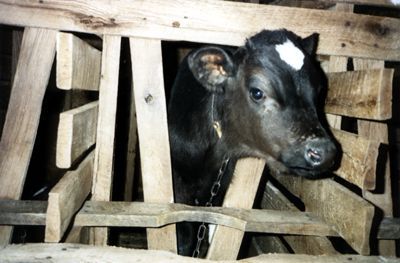
Much like a baby calf, our villain must kill something of innocence. That might be something internal or external-- taken in a literal sense. No cut of meat is born a villain... its soul must be butchered-- carved and contorted into a bloody piece of veal. Greed, lust... these are motivators, but weak ones. A great villain is disturbed, changed in some way. Show the eater of your veal the death of its innocence. Horrify them.


STEP TWO: Determine Color
You must decide how dark your want your meat-- or how red. Prior to any seasoning and prepping, choose whether you want a rare veal willing to draw blood or be lethally under-cooked. Is the soul charred beyond recognition? Is it medium? In between and seemingly good, putting on a persona and keeping its nose clean by manipulating others?

STEP THREE: Cook the Grenade
Once the color is decided, throw the veal in the oven. As you cook, give the proper heat and motives. Allow the eater to understand why the meat tastes the way it does. Allow them to detect subtle hints of how it was cooked while still maintaining an air of foreboding mysteriousness. Be sure to burn in grilling marks, scars, external evidence to the pink evil inside the Villainous Veal. Be sure to check on your meat occasionally to see the progress of its development-- the hardening of its character. It is not uncommon to burn the veal to a crisp by the time the story ends.

STEP FOUR: Add Seasoning
A villain has its quirks too-- its idiosyncrasies. What grass does did it graze upon as a young calf? What does it revel in now? How about what it hates? Hate. Hate and a perversion of love are your greatest seasonings. Dark ambition is almost required. Make it strong tasting, perhaps even chilling. Make it so bad that the eater won't be able get the taste from their tongue, or so devilishly good they can't stop eating it up. The right dressing can amaze... but it can sicken... nauseate... or kill if poisoned. 

STEP FIVE: Support with Sides
Optionally, (yet highly suggested) you may support your dark dish with some sides that will compliment your Villianous Veal and play off its sinister flavor. Perhaps a kind pawn, like a healthy yet doomed veggie. Maybe an equally mashed potato-- made evil by the meat's gravy. Tasteless and useless garnish goes a long way, like a henchman used only to fodder the villain's presentation. A lonely villain can be extremely effective, but one surrounded by sides is a force to be reckoned with.

FINAL STEP: Use your own Darkness
The cook needs to always cook a bit of itself into its creations, even the culinary disasters. Seek into the darkest recesses of your mind to find an ingredient you've chosen to hide from others. Putting your own evil into the veal--regardless of how small or repressed it is--makes the taste explode on the plate.


Now your cooking with hate, making a tragic masterpiece. Your veal may not sit well with many, but it won't   be forgotten. After all, we always remember the meals that made us sick. Food poisoning can be deadly, but it remains a constant fear in our minds.

- B